
DC’s Kryptonite is Superman
I went to see Justice League yesterday and, while it was better than most of the DC movies— admittedly not a high bar, it still fell flat in comparison to what Marvel has been producing.
I’ve been considering the whys and wherefores of DC’s continued failings on the cinematic front and have come to the conclusion that the root of the problem goes much deeper than the people involved in producing the movies. The crux lies at the heart of the DC universe itself:
Superman.
He is the gold standard for heroes. He can literally do almost anything— depending on which series of the comics you follow— and has an unshakable morality. In short, he is a god.
Now, when trying to create other heroes to exist in a universe with Superman, those heroes have to exhibit abilities which at least rival the Man of Steel, or they become laughably insignificant in comparison. Wonder Woman is almost as strong as he is, as well as having weapons of incredible power themselves; Flash is as fast— or slightly faster, again depending on which series you follow— so fast he can manipulate time; Aquaman is also incredibly strong and nigh invulnerable, especially in the water, and the list goes on.
It even seems like DC understands their problem, to a degree, when young Barry Allen asks Bruce Wayne what his super power is in the movie.

***SPOILERS AHEAD***
***
***
You have been warned. 🙂
So, the movie begins in the aftermath of Batman vs. Superman: a world that is now bereft of the man of steel and new threats are looming. Batman works on putting the band together and the big bad, Steppenwolf, (DC has always had a terrible time with names, in addition to their Superman problem) is doing his bit to bring an apocalyptic end to Earth. He does an impressive job in the beginning, wading through the Amazonians and Atlanteans to gain two of the pieces to his Unity puzzle box, and mostly puts the smack-down on Batman’s newly-formed team while trying to find the third and final piece.
To this point, the movie is pretty good for the most part and I was enjoying it. The characters were flat, but there’s only so much time for development in a team-up story such as this, so I was willing to forgive a few stereotypes and obvious gags. Because of the defeat, however, Batman decides the only way they can win is to try to raise Superman from the dead.
And it went downhill from there.
The fight scenes were amazing and comic book-esque, but all of the tension the story had built to that point evaporated once Superman returned and regained his senses upon seeing Lois Lane after the obligatory hero vs hero battle.
The big bad and all he had wrought suddenly became no more than a comic foil for the heroes and the concluding battle was just an excuse to smash stuff. Steppenwolf was barely an annoyance for Superman and only delayed his defeat because Superman had to go save a building full of innocent bystanders while Flash rescued one family in a pickup truck.
The apocalypse ended with a whimper and a laugh.
Hero stories are about someone overcoming incredible odds to eventually triumph against an implacable foe. The presence of Superman turns that on its head and suddenly the bad guys become insignificant and the other heroes merely sidekicks.
Pulling back and looking at the bigger picture, humans themselves become completely irrelevant in a world with Superman. The only ones who can carry water for him are like gods themselves: Wonder Woman, Flash, Aquaman, Cyborg. Commissioner Gordon exemplifies this when he calls for Batman to ask about a series of abductions in the film, claiming the police force could find no pattern to them. Half a second later, the heroes spout off a complete analysis of what they’re shown and disappear to act on the information. The message there is clear:
Regular people have nothing to contribute.
Who wants to live in a world like that?
Marvel’s universe has some incredibly powerful beings too, but they are also flawed in many ways, which makes them more relatable as characters. Normal people can still have an impact in that world, which, for me, makes for a much more interesting and enjoyable fantasy.
Please, tell me what you think! Did you enjoy the movie? Disagree with my assessment? I’d love to hear your opinions.
The Only One in Charge of Your Beliefs is You.
Originally posted on Medium.com
A thousand years ago, people seriously debated whether the Earth was round or flat.
A hundred and fifty years ago, people seriously debated whether slaves were human beings or not.
A hundred years ago, people seriously debated whether women should have the right to vote.
These debates sound silly to most of us now, but at the time, they were vital discussions with two clearly opposed points of view that were held in equal esteem by the parties involved.
What debates are we having today that will seem frivolous to future generations?

I’m old enough to remember when you could find a box of crayons containing a color labeled “flesh.” As a Caucasian child, living in a predominantly Caucasian community, I thought nothing of it. Now, I wonder what a child of a different ethnic background might have felt about that innocent wax stick. Wikipedia tells us the color was renamed “peach” in 1962, yet I used one with the outdated label over ten years later. My parents would have considered it perfectly normal to have a “flesh” color within their box to choose from. What once was normal now seems insensitive and even racist to many of us.
How did that change occur? It didn’t happen suddenly, in spite of a decision by Crayola to alter the name one day in 1962. It came about over time because, one by one, people chose to adjust their beliefs about the color of one’s skin and what it meant to them. Not everyone made an adjustment — as we clearly see in the world today — but enough did to slowly create a new normal that children grew up with. That new normal, however, would never have blossomed without the internal examinations of thousands of individuals and their belief systems.
We each have a responsibility to constantly question our beliefs — whatever they may be. Many choose to ignore that responsibility and surround themselves with voices that only confirm what they already think. Social media too often serves as an insulator to the world, rather than the open forum it was intended to be. We block or ignore people and sites that say things contrary to our held opinions, then favorite and like ones that agree with our comfortable world view. This practice shunts our ability to think critically and quiets the voice inside us that questions our reality — to the point where we will do and say things we would have once considered ridiculous.
Pay attention to your actions and behavior while online. Ask yourself why you liked that post, or blocked that site from your feed. Was the source questionable, even though it confirmed something you believe? Did the content make you uncomfortable because it conflicted with something you hold true?
Willingly blinding yourself to the world only serves to hinder your growth as an individual and our society as a whole.
In the end, you are the only one in charge of what you believe.
SFF Book Bonanza
I’m guest posting over on the SFF Book Bonanza blog! Come have a look and tell me about your favorite genre-mashing stories!
http://sffbookbonanza.com/2017/04/24/genre-blending-mashing-bending/
Time Travel Stories Never Account for This One Thing
Don’t be surprised to see flashing lights behind you and hear a police siren while you read this blog post. And it’s not because that slightly illegal prank you pulled in your youth has finally caught up with you.
You’re speeding.
Yep. Sitting in your chair, sipping your coffee or munching on your favorite snack, you are moving at a pretty ridiculous clip.
We experience day and night because the Earth rotates. Being an inhabitant of the Earth and subject to its gravity, that means we are spinning along with it. Standing at the equator, you would be moving at the rate of just over 1,000 miles per hour. In the middle latitudes, where most of the human population resides, it’s roughly two-thirds of that, or six-t0-seven hundred miles an hour.
And your mom always complained about you being so slow to get ready for school in the morning!
We can’t stop there, though. We all know the Earth revolves around the sun. How fast does it have to move to do so? Pretty damn fast, as it turns out. In order for the Earth to make a complete trip around the sun in the span of a year, at a distance of ninety-three million miles away from the burning ball of hydrogen, it has to move approximately 66,000 miles per hour.
You’re really booking it! No wonder the cops are after you!
But, back to the headline of this post: time travel. Why is this movement through space important?
Let’s look at one of the most famous examples of time travel from popular culture: Doc Brown’s first experiment with Einstein the dog in Back to the Future.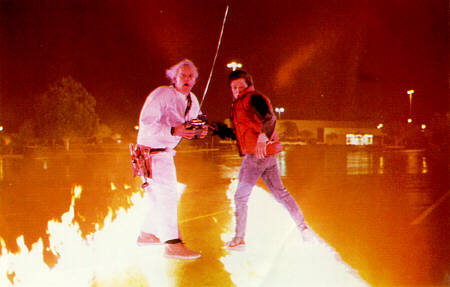 In the movie, Doc sends his pooch, strapped into the famous DeLorean, one minute into the future to arrive at the exact same spot. Yet, in order to do that, he would not only have to travel through time, but space as well. Consider how far you move, sitting in your chair, in the span of a minute.
Rotationally, spinning along with the Earth, you travel ten or eleven miles in that single minute. In addition, you’ve moved about 1,100 miles with the Earth following its orbit around the sun!
“All right then,” you say. “Maybe we can travel through time in exact-year increments.”
Interesting thought, but we’re not done calculating your speeding violation.
In addition to the Earth rotating and revolving around the sun, the sun is also moving at a pretty astounding pace, and dragging all of us with it in the general direction of the star Vega, within the constellation Lyra. That motion is calculated at roughly 43,000 miles per hour. Yet, even that isn’t all. The sun and our solar system also orbit within our Milky Way galaxy as it spins. Our speed as we waltz around the mysteries at the center of our galaxy? Merely 483,000 miles per hour.
That’s over 8,000 miles per minute. And we’re still not done.
The Milky Way itself is also moving, hurtling away from a universal central region we associate with the Big Bang. That speed? 1.3 Million miles per hour, or over 21,500 miles per minute.
So, in a single year— one trip around our sun— the Earth is displaced several billion miles through space from its starting point across a number of vectors of direction.
In order to travel through time to visit our own past or future, we must travel vast distances through space as well. I turned 50 years old this past year. If I wished to witness my own birth, I’d have to not only pass through those years of time, but also half a trillion miles of space!
Don’t get me wrong, I adore time travel stories— I’ve written a few! And Back to the Future is one of my all-time favorites, but it’s also fun to think about the bigger picture of time travel and what it entails. Our universe is an incredibly complex mechanism that we’ve only barely begun to understand. Maybe one day we’ll crack the code that will allow us to bounce around willy-nilly through space and time. Until then, we’ll just have to let our imaginations wander the reaches and laugh at the exploits of Doc Brown and Marty McFly.
“I’m sorry, Officer. I had no idea I was going that fast.”
Playlist for The Devil You Know
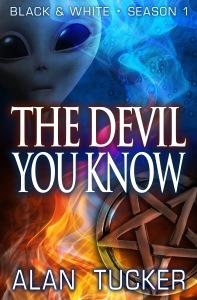 Popular music is an integral part of my newest book, The Devil You Know. A large number of songs, both old and new, are referred to in the novel, so I thought I’d create a playlist of sorts for people who’d like to inject an additional element into the story as they read: audio! Below is a YouTube link to each song, queued up to the referenced portion, if applicable, listed by Episode and Chapter. Enjoy!
Episode One:
Chapter 1:
Destiny’s Child, Say My Name https://youtu.be/sQgd6MccwZc
The Doors, Light My Fire https://youtu.be/LY1l8T2Lcl0
Episode Two:
Chapter 9:
Celine Dion, All By Myself https://youtu.be/NGrLb6W5YOM
Episode Four:
Chapter 17:
Maroon 5, Animals https://youtu.be/qpgTC9MDx1o
Jimi Hendrix, Foxy Lady https://youtu.be/lp0sUGlam6c
Robert Palmer, Simply Irresistible https://youtu.be/UrGw_cOgwa8
Episode Five:
Chapter 26:
The Commodores, Lady https://youtu.be/phNLASyPsUU
Episode Six:
Chapter 32:
Queen, Another One Bites the Dust https://youtu.be/rY0WxgSXdEE
Episode Eight:
Chapter 46:
Adele, Hello https://youtu.be/YQHsXMglC9A
Episode Nine:
Billy Joel, We Didn’t Start the Fire https://youtu.be/eFTLKWw542g
Chapter 58:
The Hooters, All You Zombies https://youtu.be/2LE0KpcP05I
Episode Ten:
Chapter 68:
Tom Petty and the Heartbreakers, I Won’t Back Down https://youtu.be/nvlTJrNJ5lA







 Our Great Escapes